
When homeowners think about their roof, they typically think about shingles, leaks, and maybe gutters. Ventilation rarely enters the conversation — yet poor attic ventilation is one of the most common and most preventable causes of premature roof failure, high energy bills, and interior moisture damage.
At Cal Coast Roofing, we evaluate attic ventilation on every roof inspection we perform, and we regularly find homes where the ventilation system is inadequate, improperly installed, or missing entirely. Here’s what every Bay Area homeowner should know.
What Is Roof Ventilation and How Does It Work?
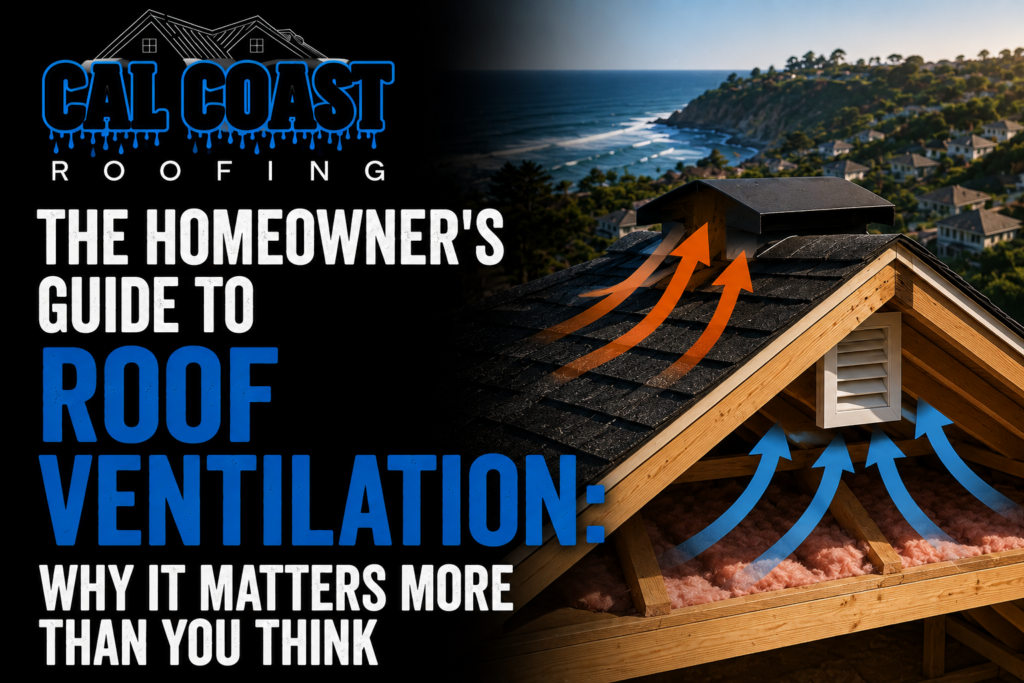
Roof ventilation is a system designed to move air continuously through your attic space. A properly ventilated attic has two types of openings working together:
Intake Vents
Intake vents are located at the lowest part of the attic, typically along the soffit (the underside of your roof’s overhang). They allow cool, fresh outside air to enter the attic at the bottom.
Exhaust Vents
Exhaust vents are located at or near the roof’s ridge — the highest point. They allow hot, moist air to escape from the top of the attic. Common types include ridge vents (which run the full length of the roof peak), box vents (individual static vents placed near the ridge), and powered attic fans.
The combination of intake at the bottom and exhaust at the top creates a natural convective flow: cool air enters, warms as it rises, and exits at the top — continuously cycling fresh air through the attic space. This process is passive and ongoing, requiring no mechanical energy when designed correctly.
What Happens When Attic Ventilation Is Inadequate?
Without proper airflow, your attic becomes a closed system that accumulates heat and moisture. The consequences affect every component of your roofing system.
Accelerated Shingle Deterioration
During summer, an unventilated attic can reach temperatures of 150°F or more. That extreme heat doesn’t just make your home uncomfortable — it cooks your shingles from below. Asphalt shingles are designed to shed heat from above, but sustained heat from beneath accelerates the loss of flexibility, causes blistering, and significantly shortens the shingle’s useful life.
Roofing manufacturers take ventilation so seriously that many of them will void their shingle warranty if it can be demonstrated that inadequate ventilation contributed to the product’s failure. Ventilation isn’t a bonus feature — it’s a warranty requirement.
Moisture Buildup and Wood Rot
In fall and winter, warm, moist air from the living space below rises into the attic. In a poorly ventilated attic, this moisture has nowhere to go. It condenses on the cold wood surfaces of the decking and rafters, leading to:
- Mold and mildew growth on attic framing and insulation
- Wood rot in the decking, which can compromise the structural integrity of the entire roof system
- Rust on metal fasteners, flashings, and any metal components in the attic space
- Damaged insulation that loses its R-value as it absorbs moisture
By the time wood rot is visible, it has often been developing for months or years.
Ice Dams (Less Common in the Bay Area, but Relevant)
In colder climates, poor ventilation is the primary cause of ice dams — ridges of ice that form at the eaves and prevent snowmelt from draining. While ice dams are rare in the San Jose and Santa Cruz areas, homes at higher elevations in the Santa Cruz Mountains can be affected during cold winters. Proper ventilation prevents the uneven roof surface temperatures that cause ice to form.
Higher Energy Bills
A superheated attic in summer acts like an oven above your living space, forcing your air conditioning system to work significantly harder. Proper ventilation dramatically reduces attic temperatures and the cooling load on your HVAC system — a meaningful benefit in the South Bay’s warm summer months.
How Much Ventilation Does Your Attic Need?
The general building code standard in the United States is a minimum of 1 square foot of net free ventilation area for every 150 square feet of attic floor space. This is often expressed as the 1:150 ratio. If the ventilation is evenly balanced between intake and exhaust, some codes allow a 1:300 ratio.
In practice, many homes — particularly older homes — fall significantly short of this standard. Intake vents are often blocked by insulation that was pushed into the soffits during a retrofit, or the soffit vents themselves may be too small or spaced too far apart.
Signs Your Attic Ventilation May Be Inadequate
You don’t need to be a roofing professional to spot potential ventilation problems. Watch for these indicators:
Inside the Attic
- Attic feels extremely hot in summer — noticeably hotter than outdoors
- Visible moisture staining or dark streaks on roof decking or rafters
- Frost on the decking in winter
- Mold or mildew smell
- Insulation that appears wet, matted, or discolored
On the Roof
- Shingles that appear blistered or show premature granule loss
- Ridge or box vents that appear blocked or capped
- No visible soffit vents along the eaves
Inside the Home
- Upstairs rooms that are consistently much hotter than downstairs in summer
- Energy bills that seem unusually high during cooling season
- Persistent musty odors coming from the attic
Common Ventilation Mistakes We See
Mixing Exhaust Vent Types
One of the most common ventilation errors is installing both ridge vents and box vents (or other exhaust vent types) on the same roof. When this happens, air short-circuits between the two exhaust sources rather than drawing in fresh air from the soffit intake. This can actually reduce ventilation effectiveness compared to using a single exhaust type consistently.
Blocked Soffit Vents
During insulation projects, it’s extremely common for installers to push insulation into the soffit area and cover the intake vents. Without intake, exhaust vents have nothing to pull from and the system stops functioning. Attic baffles (also called rafter baffles or vent chutes) prevent this by creating a clear channel from the soffit vent to the open attic space.
Powered Fans Without Adequate Intake
Powered attic fans can be effective when paired with sufficient intake ventilation, but when installed in attics with undersized soffits, they pull conditioned air from the living space below through gaps in the ceiling — actually increasing energy costs rather than reducing them.
What Cal Coast Roofing Evaluates
During every inspection, our team evaluates your attic’s ventilation system as a whole — measuring the approximate ventilation ratio, checking for blocked intakes, confirming exhaust vent placement, and looking for evidence of heat or moisture damage. If we find deficiencies, we’ll explain exactly what’s needed and why.
Proper ventilation is one of the most cost-effective investments a homeowner can make. In many cases, improving an attic’s ventilation system adds years to a roof’s lifespan and pays for itself in reduced energy costs within a few seasons.
Contact Cal Coast Roofing to schedule your free roof inspection throughout San Jose, Saratoga, Los Gatos, Campbell, Santa Cruz, Scotts Valley, and the surrounding South Bay.