
Skylights are one of the most desirable features in a home — they fill interior spaces with natural light, create an open, airy feel, and can dramatically improve the livability of rooms that would otherwise feel dark or enclosed. They’re also one of the most common sources of roof leaks we encounter at Cal Coast Roofing.
The good news is that a leaking skylight doesn’t necessarily mean the skylight itself has failed. In many cases, the skylight unit is perfectly functional and the leak is entirely a flashing problem — which is a much less expensive fix than skylight replacement. Understanding the difference is the key to addressing the problem correctly the first time.
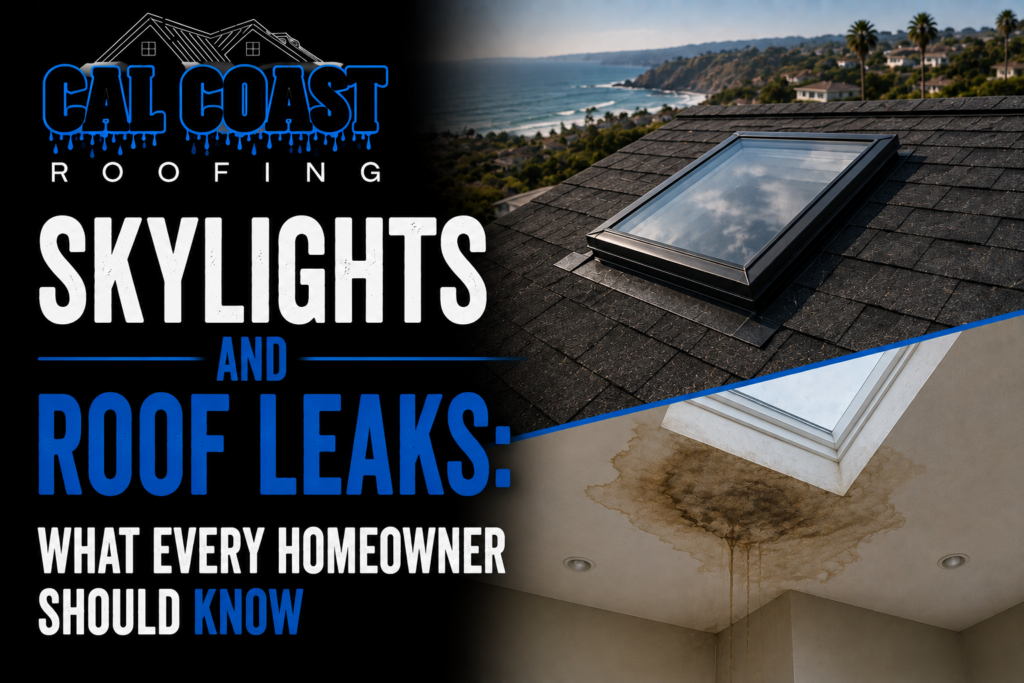
Why Skylights Leak
Skylights create penetrations through the roof surface — one of the fundamental challenges in roofing. Any time you cut a hole in a roof, you create an opportunity for water infiltration if the perimeter is not continuously and correctly sealed. Skylights are particularly vulnerable because they sit at a fixed point in the roof while the roof surface around them expands and contracts with temperature changes, the skylight frame itself moves slightly with the structure of the home, and debris accumulates around the perimeter.
Failure Mode 1: Flashing Failure
What It Is
Flashing failure is by far the most common cause of skylight leaks. Every skylight has a flashing system around its perimeter that creates a watertight seal between the skylight frame and the roof surface. When this flashing fails, water infiltrates not because the skylight unit itself has leaked, but because the connection between the skylight and the roof has failed.
Why It Happens
Skylight flashing fails for several reasons: age and UV degradation of sealants, improper original installation, roof replacement without flashing replacement, and thermal movement between the roof surface and skylight frame.
If a previous roofer left the original flashing in place during a re-roof, that flashing may now be 20 or 30 years old even if the shingles around it are relatively new.
How to Identify It
If the leak appears at the perimeter of the skylight — along the sides or at the base of the frame — rather than through the glass or glazing itself, flashing failure is the most likely cause.
The Repair
A proper flashing repair involves removing the existing flashing, inspecting the underlying roofing and decking around the skylight, and installing a new manufacturer-specific flashing kit. When done correctly, a flashing repair can fully resolve a skylight leak and provide another 15–25 years of watertight performance.
Failure Mode 2: Skylight Unit Failure
What It Is
The skylight unit itself — the glazing and the frame — can fail independently of the flashing. This happens when the seal between the glazing and the frame breaks down, allowing water to penetrate through the unit rather than around it.
How to Identify It
Water appearing at the center of the skylight opening — dripping from the glass or appearing inside the frame — rather than at the perimeter indicates a unit failure. You may also notice fogging between double-pane glass panels, which indicates a failed thermal seal.
The Repair
Seal failures on older skylight units are generally not repairable in a lasting way — the solution is skylight replacement. If your skylight is older than 20 years and the unit itself is leaking, replacement is almost always the right call.
Failure Mode 3: Condensation Mistaken for a Leak
Not every wet appearance at or near a skylight is a leak. In poorly ventilated spaces, warm interior air rises and contacts the cold underside of the skylight glazing, condensing into water droplets that can drip and stain the surrounding ceiling. Condensation typically appears during cold weather rather than consistently after rain events, and the moisture appears on the interior face of the glazing rather than at the frame perimeter.
When to Replace vs. Repair
Repair the flashing if: the skylight unit is less than 15 years old, the glazing is clear and intact, and the leak appears at the perimeter of the frame.
Replace the skylight if: the unit is 20 or more years old, the glazing is cracked or fogged between panes, or moisture appears through the glazing itself.
Always replace flashing when replacing the roof. Never leave original skylight flashing in place under new shingles. The incremental cost during a re-roof is minimal; addressing a leak through new shingles afterward is not.
Cal Coast Roofing: Skylight Leak Diagnosis and Repair
We diagnose and repair skylight leaks throughout San Jose, Saratoga, Los Gatos, Campbell, Santa Cruz, Scotts Valley, and the surrounding South Bay. Contact us today for a free inspection.