Accessory Dwelling Units — ADUs — have become one of the most popular home improvement projects in the Bay Area over the past several years. Changes to California state law have dramatically streamlined the ADU permitting process, and with housing demand what it is across San Jose, Santa Cruz, and the South Bay, many homeowners are adding ADUs as rental income, multigenerational housing, or long-term investment.
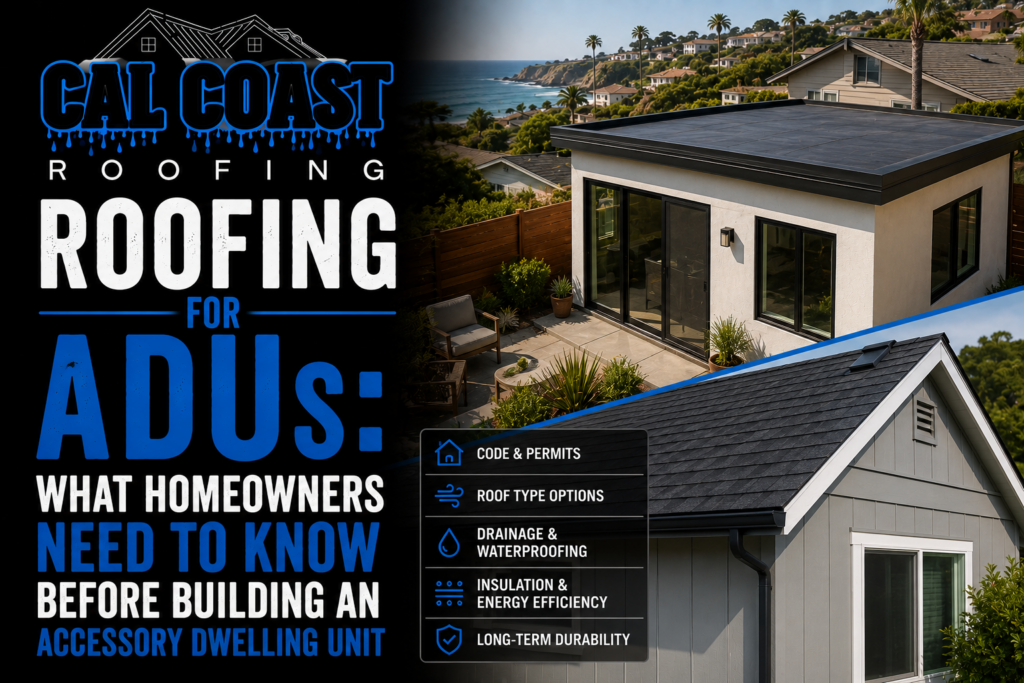
Roofing is one of the most consequential decisions in any ADU build. The right choice affects the structure’s appearance, its energy performance, its fire protection level, and how well it integrates visually with the primary residence. At Cal Coast Roofing, we work on ADU projects throughout the region. Here’s what every homeowner planning an ADU should understand before breaking ground.
Why Roofing Decisions Matter More on an ADU
The ADU Is a Permanent Structure With Its Own Roofing System
An ADU is not a temporary shed or a garage conversion where roofing is an afterthought. It’s a permanent, permitted dwelling unit that will be occupied, rented, or sold as part of your property. Its roof needs to be designed, installed, and warranted to the same standard as your main home — and it needs to last.
Cutting corners on ADU roofing to save upfront cost is one of the most common mistakes we see. The incremental cost difference between a quality roofing system and a minimum-standard one is modest relative to the total ADU construction budget — but the consequences of a poorly performing roof on a rental unit or multigenerational home are significant.
Curb Appeal and Property Value
Your ADU is visible from the street and contributes to your property’s overall appearance and appraised value. A roof that clashes with your main home — in color, material, or quality — detracts from that value. Getting the roofing right means thinking about how the two structures work together visually.
Roofing Material Options for ADUs
Architectural Asphalt Shingles
For most ADU applications, architectural asphalt shingles are the appropriate starting point. They’re cost-effective, widely available, compatible with a broad range of architectural styles, and offer a 25–30 year lifespan. Matching the shingle color and product line to your main home creates visual cohesion across the property.
For ADUs with simple gable or hip rooflines — the most common ADU configurations — architectural shingles are typically the right call. They perform well on pitches as low as 2:12 with proper underlayment and installation, giving you design flexibility.
Metal Roofing
Metal roofing is increasingly popular for ADUs, particularly in modern and contemporary architectural styles. A standing seam or metal panel roof on an ADU creates a clean, contemporary aesthetic that reads as intentional rather than mismatched — especially effective when the ADU is designed as a clearly separate structure from a more traditional main home.
Metal also makes strong practical sense for ADUs in fire-prone areas (more on this below), and the minimal maintenance requirements are particularly appealing for a rental unit where the homeowner may not want to manage ongoing roof maintenance.
Flat / Low-Slope Roofing
Many ADU designs — particularly garage conversions, modern detached studios, and compact backyard cottages — incorporate flat or low-slope rooflines. These require TPO membrane or modified bitumen systems rather than conventional shingles.
Flat-roof ADUs are popular because they’re architecturally versatile, structurally simpler to frame, and can incorporate rooftop decks or mechanical equipment more easily. The trade-off is a shorter roofing system lifespan (15–25 years) and the need for more attentive drainage maintenance.
Fire Zone Requirements — Critical for Many Bay Area ADUs
Much of the Santa Cruz Mountains, the Los Gatos foothills, the Saratoga hills, and scattered areas throughout San Jose and the South Bay are designated as High or Very High Fire Hazard Severity Zones (FHFHSZ) by CAL FIRE and local jurisdictions. In these zones, California building code requires that all new construction — including ADUs — use Class A fire-rated roofing materials.
Class A is the highest fire rating available and requires that the roofing system be non-combustible or demonstrate the ability to resist severe fire exposure. The materials that qualify include:
- Architectural asphalt shingles with a Class A rating (most modern architectural shingles qualify — confirm with the manufacturer)
- Metal roofing (Class A rated by nature of the material)
- Concrete or clay tile
- Class A rated flat roof systems
Wood shake and standard three-tab shingles typically do not qualify as Class A and cannot be used on new ADU construction in fire hazard zones. Before finalizing your ADU roofing choice, confirm whether your property falls within a fire hazard severity zone. Your contractor or local building department can verify this during the permit application process.
Permit and Inspection Requirements
All ADU roofing in California requires a building permit. As part of the permit process, the roofing system will be specified in the plan set and must meet applicable code requirements for fire rating, minimum roof pitch for the chosen material, underlayment type and installation, and California’s Title 24 energy code compliance.
Your roofing contractor should be familiar with local permit requirements and should pull the roofing permit as part of the project. If you’re working with a general contractor on the full ADU build, confirm explicitly who is responsible for the roofing permit and inspection.
Matching Your ADU Roof to Your Main Home
Match material class where possible. If your main home has a tile roof, a tile or metal ADU roof reads as more intentional than asphalt shingles. If your main home has asphalt shingles, matching the product line and color family creates cohesion.
Don’t feel obligated to match exactly. A detached ADU that’s clearly a secondary structure can have its own identity — a standing seam metal roof on a contemporary studio ADU looks purposeful even against a traditional shingled main home.
Coordinate color carefully. Regardless of material, roofing colors that are in the same tonal family as your main home — both warm-toned or both cool-toned — read as intentional. Clashing undertones are more noticeable than most homeowners expect.
Cal Coast Roofing for Your ADU Project
We install roofing on ADU projects throughout San Jose, Saratoga, Los Gatos, Campbell, Santa Cruz, Scotts Valley, and the surrounding South Bay. Whether you’re breaking ground on a new detached ADU, converting a garage, or finishing an above-garage unit, we’ll help you choose the right system, pull the required permits, and install it correctly the first time.
Contact us today for a free consultation and estimate on your ADU roofing project.