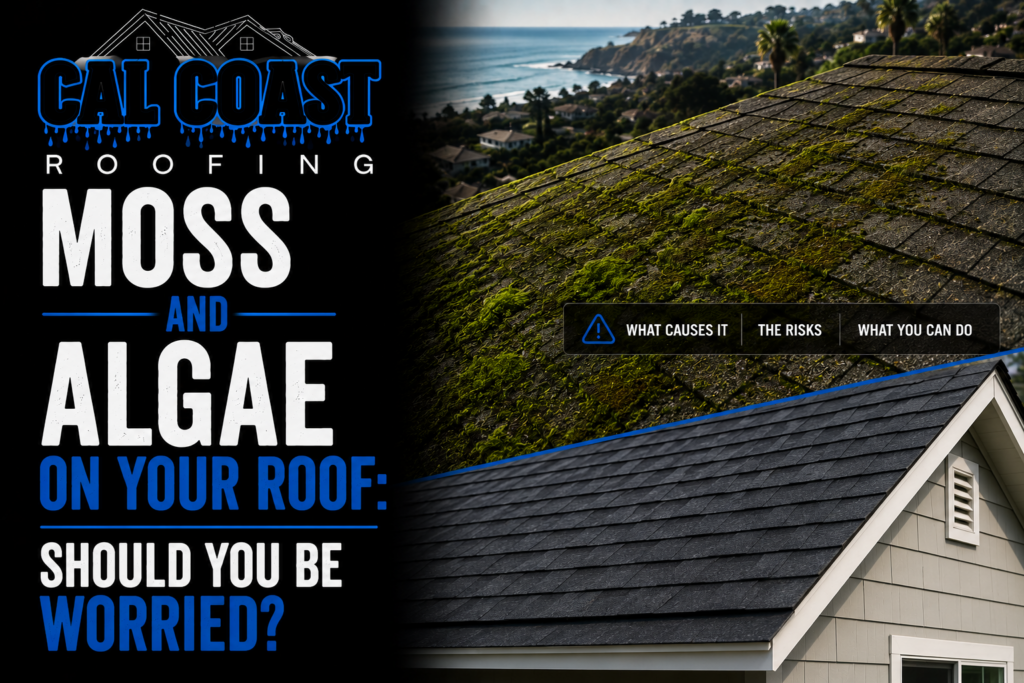
If you’ve noticed green patches, black streaks, or a general darkening across your roof surface, you’re looking at one of the most common roofing issues in the Bay Area and Santa Cruz coastal climate: biological growth. Moss and algae thrive in the same cool, moist, shaded conditions that define much of our region — and while they’re easy to dismiss as purely cosmetic, they can cause real, progressive damage to your roofing system if left unaddressed.
Moss vs. Algae: What’s the Difference?
Algae (Gloeocapsa Magma)
The dark black or dark green streaking you see running down roof slopes is almost always algae — specifically a species called Gloeocapsa magma. Despite looking like dirt or mold, these streaks are living organisms that feed on the limestone filler in asphalt shingles. Algae spreads by airborne spores and establishes quickly in shaded, moist areas. The dark color is a protective coating the algae produces to shield itself from UV exposure — which means it won’t simply disappear in summer sun.
Moss
Moss is the green, three-dimensional, plant-like growth that accumulates in roof valleys, along edges, and in any area where moisture is retained. Unlike algae, moss has root-like structures (rhizoids) that physically penetrate into shingle surfaces, actively lifting shingle edges and working their way into the granule coating. Moss holds moisture against the roof surface continuously — even during dry periods — because its sponge-like structure retains water long after rain has stopped.
Lichen
Lichen is a combination of algae and fungus and is the most tenacious of the three. It bonds directly to the shingle surface with a root structure that is difficult to remove without damaging the shingle beneath. Lichen typically appears as grayish-white, crusty, irregular patches.
What Damage Does Biological Growth Actually Cause?
Algae: Primarily Cosmetic, But With Consequences
Algae is mainly a cosmetic issue in the short term, but the algae feeding on limestone filler in asphalt shingles gradually degrades the shingle substrate. More significantly, algae establishes the moist, shaded microenvironment that moss and lichen subsequently colonize. Treating algae early prevents the more damaging growth stages that follow.
Moss: Structural Concern
Moss causes direct physical damage to shingles. Its rhizoid structures lift shingle edges, breaking the bond between shingle courses and allowing wind-driven rain to penetrate beneath. Moss also accelerates granule loss — as it grows into and under shingles, the mechanical action strips granules from the asphalt surface, removing the UV protection and weather resistance those granules provide.
Lichen: Long-Term Surface Damage
Lichen’s bonded root structure means that when it’s removed, it takes some of the shingle surface with it. Old lichen infestations that are removed often leave bare, rough patches where granules have been stripped away. Early treatment is strongly preferable to waiting until growth is severe.
Why the Bay Area and Santa Cruz Are Particularly Vulnerable
The combination of mild temperatures, significant annual rainfall, marine layer humidity, and abundant tree cover creates near-ideal conditions for roof biological growth. North-facing slopes and roofs shaded by mature oaks, redwoods, or other large trees are especially prone. Homeowners in the Santa Cruz Mountains, the wooded areas of Los Gatos and Saratoga, and coastal communities see some of the highest rates of moss and algae accumulation in the region.
How to Safely Address Moss and Algae
What NOT to Do
Do not pressure wash asphalt shingles. This is the most common mistake homeowners make. Pressure washing strips granules from the shingle surface, dramatically shortening shingle lifespan. The pressure also forces water under shingle edges and can dislodge or crack shingles.
Do not use copper or zinc strips alone as a primary treatment. Metal strips at the ridge release biocidal ions that inhibit biological growth downslope — but they work slowly and only affect the area directly below the strip. They’re a useful preventive measure, not an effective treatment for existing established growth.
Effective Treatment Options
Low-pressure soft washing with a biocidal solution is the professional standard. A properly diluted sodium hypochlorite or specialized roof cleaning solution is applied at low pressure, allowed to dwell, and then rinsed. This kills biological growth without damaging the shingle surface.
Professional moss removal for established infestations should be done by hand — carefully lifting and removing moss mats — followed by a biocidal treatment. This requires safe roof access and an understanding of how to remove growth without mechanically damaging shingles.
Zinc or copper ridge strips after treatment help slow re-establishment of biological growth and are a cost-effective ongoing maintenance strategy for shaded roofs.
Algae-Resistant Shingles
If your roof is due for replacement and you’re in a heavily shaded location, consider algae-resistant shingles. Products like GAF’s Timberline CS or CertainTeed’s Landmark IR incorporate copper granules that inhibit algae growth throughout the shingle’s lifespan.
Cal Coast Roofing: Roof Moss Treatment and Inspection
Cal Coast Roofing provides roof moss treatment, biological growth assessments, and full roof evaluations throughout San Jose, Saratoga, Los Gatos, Campbell, Santa Cruz, Scotts Valley, and the South Bay. Contact us today to schedule your free roof inspection.