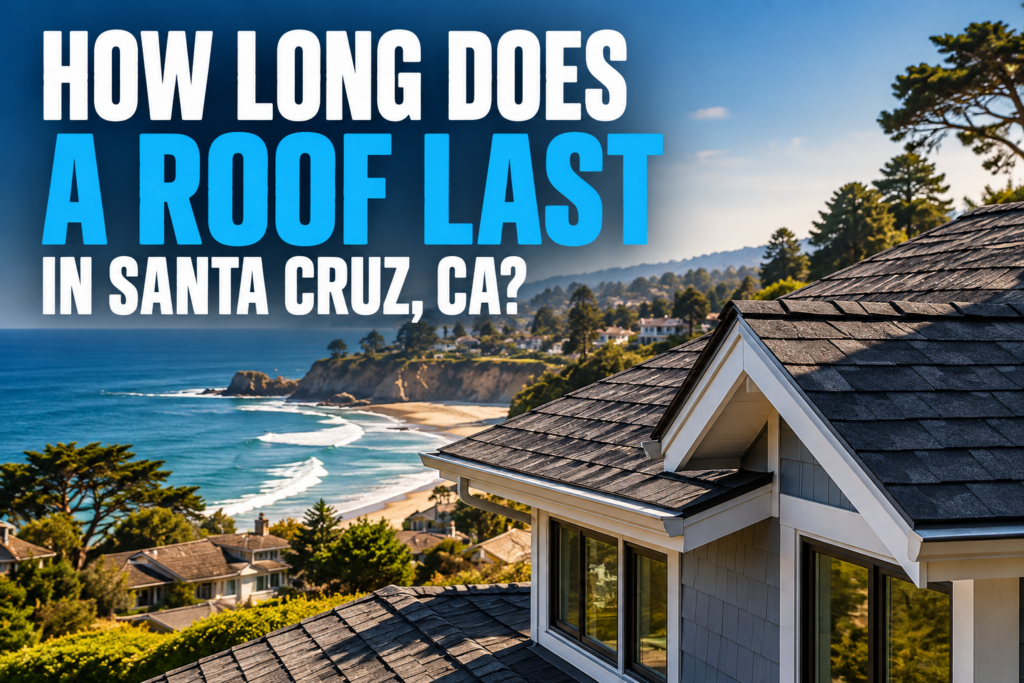
The textbook answer is 20–30 years for asphalt shingles. The Santa Cruz answer is usually shorter. Between the marine layer, salt air off the bay, UV intensity in summer, and the occasional atmospheric river that dumps six inches of rain in a day, your roof is working harder here than it would in Sacramento or Phoenix.
This guide breaks down real-world roof lifespans by material for the Santa Cruz climate — and the early warning signs that tell you replacement is coming before a leak does.
Why the Santa Cruz Climate Is Hard on Roofs
Santa Cruz sits at the edge of Monterey Bay, which means coastal exposure even for homes that aren’t directly on the water. That exposure brings several factors that accelerate roofing wear:
- Salt air: Airborne salt deposits on roofing materials, fasteners, and flashing. Over years, it corrodes metal components and degrades granule adhesion on asphalt shingles.
- Moisture cycling: The marine layer rolls in most mornings, then burns off. This daily wet-dry cycle is one of the primary drivers of premature shingle cupping and granule loss.
- UV exposure: Once the fog burns off, Santa Cruz gets strong UV. Roofing materials that hold up well in humid climates can still crack and dry out from the UV side.
- Storm intensity: El Niño years routinely bring 50+ mph wind events and concentrated rainfall. A roof at 15 years old that looks fine may not survive its first real atmospheric river without incident.
- Moss and algae: The combination of morning moisture and afternoon warmth creates near-perfect conditions for biological growth, which holds water against the surface and accelerates decay.
None of this means your roof will fail early. It means you need to know what to watch for and pick materials that are rated for coastal conditions.
Asphalt Shingles: 15–22 Years in Santa Cruz
Asphalt shingles are by far the most common roofing material on Santa Cruz homes, and for good reason — they’re affordable, widely available, and when installed correctly, they hold up reasonably well. But “reasonably well” has limits here.
In inland California, a 30-year architectural shingle can often hit 25+ years with minimal intervention. On the coast, the same shingle commonly shows significant wear at 15–18 years. The culprits are salt air granule loss, moisture cycling, and biological growth.
Signs your asphalt shingles are approaching end of life:
- Granule accumulation in gutters (especially after rain)
- Shingles that are curling at the edges or cupping upward in the center
- Dark streaking from algae growth (especially on north-facing slopes)
- Patches of shingles that look noticeably lighter or bald compared to the rest
- Daylight visible in the attic when you look up from inside
If you’re seeing three or more of these signs, a full roof replacement is likely more cost-effective than continued patching.
Tile Roofing: 30–50 Years
Concrete and clay tile roofs are popular in Santa Cruz, and they earn their reputation for longevity. Tile itself is extremely durable and resists salt air corrosion well. The tile usually isn’t what fails — it’s everything underneath it.
The underlayment beneath tile has a much shorter lifespan than the tile itself: typically 20–25 years. When it fails, you get leaks that travel under the tile and are difficult to trace. Many homeowners discover their “good-looking” tile roof has been leaking internally for years.
Tile roofs also carry significant weight — typically 900–1,200 lbs per square (100 sq ft). Older Santa Cruz homes built before tile was common may not have the structural capacity to support it without framing reinforcement. This is something a professional roof inspection will catch before installation begins.
If your tile roof is over 25 years old and you’re getting interior moisture or ceiling staining, the tile may look fine while the underlayment has failed beneath it. Budget for a full underlayment replacement and resetting of the tile, not just a patch.
Metal Roofing: 40–70 Years
Standing seam metal is the best performer in coastal California climates — full stop. Properly installed with corrosion-resistant coatings, metal roofing handles salt air, UV, moisture cycling, and high winds without the degradation issues that affect asphalt or wood.
The trade-off is upfront cost. Metal roofing typically runs 2–3x the cost of asphalt shingles per square foot installed. For a homeowner planning to stay in their house for 20+ years, the math often works out in metal’s favor when you factor in the eliminated replacement cycle. For someone who might sell in 10 years, the calculus is different.
One important note: not all metal roofing is equal for coastal conditions. Standard Galvalume panels will corrode faster near the ocean. Look for panels with Kynar 500 coatings or specify PVDF-coated products rated for marine environments.
Wood Shake: 15–20 Years (With Serious Maintenance)
Wood shake roofs look great on older craftsman and mountain-style homes in the Santa Cruz mountains and Scotts Valley area. They’re also the most demanding roofing material to maintain in this climate.
Wood shake requires annual treatment, regular moss removal, and immediate attention to any cracked or split shakes. In Santa Cruz’s moisture-heavy marine environment, untreated shake can develop serious rot issues within 5–7 years. Fire rating is also a concern — most wood shake doesn’t qualify for a Class A fire rating, which matters in the WUI (wildland-urban interface) areas east of the city.
If you have wood shake and love the look, budget for annual maintenance and start planning a replacement conversation around the 15-year mark. Waiting until there’s visible damage means you’re likely already dealing with concealed rot.
Flat and Low-Slope Roofing: 15–25 Years Depending on System
Modern flat and low-slope roofs in Santa Cruz are typically finished with TPO, EPDM, or modified bitumen systems. Lifespans vary significantly by material quality and installation:
- TPO (Thermoplastic Polyolefin): 15–20 years. Reflective and energy-efficient, but seam quality at installation is critical — poor seams are the #1 failure point.
- EPDM (rubber membrane): 20–25 years when properly adhered and detailed at penetrations and edges.
- Modified bitumen: 15–20 years. A reliable performer on low-slope residential roofs, especially in torch-applied systems.
Flat roofs require drainage management. Standing water (ponding) accelerates membrane degradation and, over time, adds structural load. If your flat roof has areas where water consistently pools after rain, that needs to be addressed — either through drain relocation or tapered insulation — not just patched around.
The 15-Year Rule for Santa Cruz Homes
Regardless of material, we recommend scheduling a professional roof inspection at the 15-year mark for any Santa Cruz home. Not because your roof is necessarily failing at 15 — but because:
- Most roofing problems are detectable before they become leaks
- Early intervention (sealing, recoating, spot replacement) is far cheaper than emergency repair
- Insurance companies are increasingly scrutinizing roofs over 15 years old at policy renewal
- If replacement is coming in the next 3–5 years, knowing now lets you budget and plan instead of react to a failure
What a Roof Inspection Actually Covers
A professional inspection isn’t just someone walking your roof and saying it looks okay. A thorough inspection covers:
- Shingle or surface condition across all slopes
- Flashing integrity at all penetrations — chimneys, vents, skylights, valleys
- Gutter attachment and drainage path
- Soffit and fascia condition
- Attic inspection for moisture staining, ventilation issues, and insulation condition
- Structural observations — any visible sagging, rafter damage, or sheeting concerns
The inspection report should give you a clear picture of current condition, estimated remaining lifespan, and any immediate concerns. If a contractor can’t give you that in writing, that’s a red flag.
When to Repair vs. Replace
The general rule: if your roof is under 10 years old and the damage is isolated, repair makes sense. If your roof is over 15 years old, widespread repairs are often throwing good money at a system that’s approaching end of life anyway.
The exception is localized storm damage on a newer roof — that’s legitimately repair territory, and it may also be an insurance claim. If a recent storm caused identifiable damage to a roof that was otherwise in good shape, document it, get a professional assessment, and contact your insurance carrier before you make any repairs. Repairs completed before an insurance inspection can complicate your claim.
For Santa Cruz homes specifically: if you’re doing a roof replacement, it’s worth getting quotes for upgraded materials — either Class 4 impact-resistant shingles or metal — rather than a straight like-for-like asphalt replacement. The incremental cost may be modest relative to the longer lifespan you get in a demanding coastal climate.
Questions to Ask Any Roofing Contractor
- Are you licensed with the California Contractors State License Board (CSLB)?
- What’s your specific experience with coastal roofing conditions?
- What underlayment are you using, and what’s its rated lifespan?
- Do you pull permits for your replacements? (Required in Santa Cruz County — any contractor who skips this is a liability for you as the homeowner)
- What does your warranty cover — manufacturer defects only, or workmanship too?
If a contractor can’t answer those questions clearly and quickly, keep looking. The Cal Coast Roofing team has worked in Santa Cruz and the South Bay for years — we’ll give you straight answers on all of the above.
Not sure where your roof stands? We offer free inspections for Santa Cruz and South Bay homeowners — no pressure, just a clear picture of what you’re working with.Book Your Free Inspection