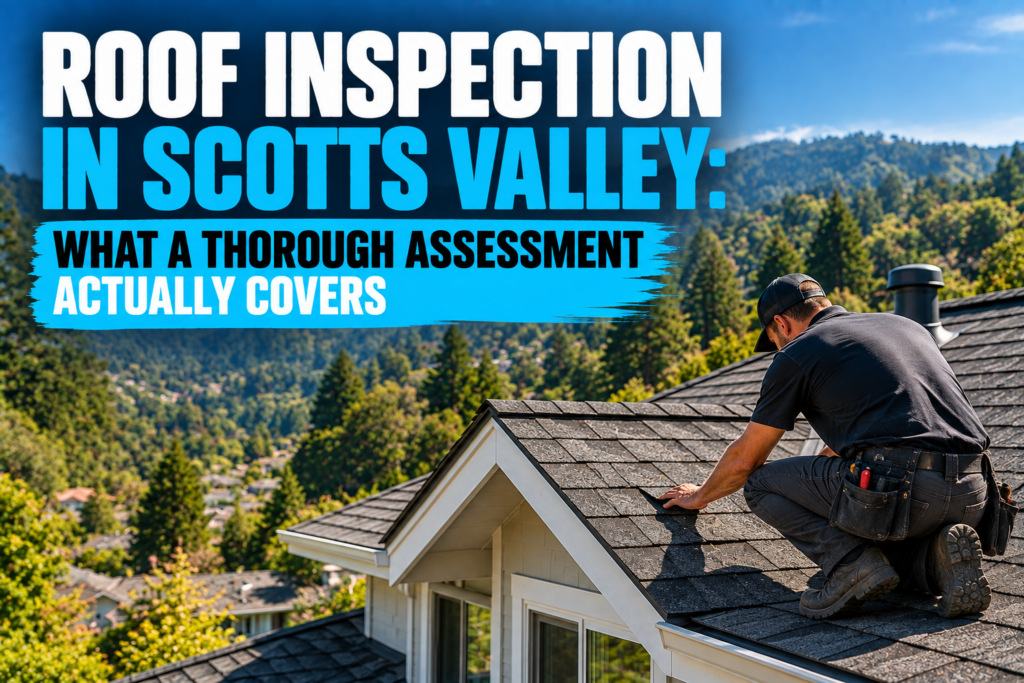
Scotts Valley sits in a microclimate that’s distinct from both coastal Santa Cruz and the drier South Bay. You’re in the Santa Cruz Mountains, with more tree coverage, more morning moisture, heavier rainfall, and meaningful fire risk from the surrounding forest. All of that makes a professional roof inspection more valuable here than in many other locations.
This guide covers what a thorough inspection should cover on a Scotts Valley home, what the results should tell you, and when to take those results seriously enough to act on them.
What Makes Scotts Valley Roofs Different
Before the inspection details, it’s worth understanding what Scotts Valley homes face that homes in other service areas don’t:
Tree coverage and debris load. Most Scotts Valley homes have significant tree cover — redwoods, live oaks, bay laurels. That means constant debris on the roof: needles, leaves, small branches. Debris holds moisture, clogs gutters, and creates the perfect substrate for moss and algae growth. A roof that’s been underneath dense tree cover for a decade looks different — and ages differently — than the same roof in a less shaded environment.
Rainfall concentration. Scotts Valley receives more rainfall than San Jose or the South Bay, and rain events here can be intense. The Santa Cruz Mountains channel precipitation in ways that produce localized heavy rain on some hillside properties. Valley and flashing details that would be adequate in a drier climate sometimes aren’t sufficient here.
Fire risk. The CZU Lightning Complex Fire in 2020 and the Loma Fire before it demonstrated clearly that the wildland-urban interface around Scotts Valley is high-risk. Roofing fire rating matters here — a Class A rated material is strongly recommended, and some homeowners who’ve rebuilt have moved to metal or concrete tile for this reason specifically.
Freeze exposure. Scotts Valley gets occasional frost and rare light snow on hillside properties above 1,500 feet. Ice dam risk is low by northern California standards but not zero. At minimum, freeze-thaw cycling affects how quickly flashing seals and roofing adhesives age.
What a Professional Roof Inspection Covers
An inspection worth paying for — or getting for free — covers these areas:
1. Exterior Surface Condition
The inspector walks the roof or, where pitch makes that unsafe, uses a drone or binoculars from the ground. They’re assessing:
- Shingle condition: granule loss, cupping, cracking, missing shingles
- Moss and algae growth — extent, location, and depth of penetration
- Debris accumulation — particularly in valleys and around penetrations where debris dams can form
- Ridge cap condition — the ridge is often the first place material failure shows
- Overall slope and surface consistency — visible sag, wavy sections, or inconsistent plane alignment
2. Flashing Inspection
Flashing failures cause more roof leaks than shingle failures, especially on older roofs in heavy-moisture environments like Scotts Valley. The inspector should check:
- Chimney flashing — step flashing and counter flashing condition and seal
- Valley flashing — woven, open, or closed valleys and their condition
- Pipe boot seals at all plumbing penetrations
- Roof-to-wall transitions on dormers, additions, or bump-out sections
- Skylight flashing if applicable
In Scotts Valley homes with older chimneys, mortar deterioration at the chimney crown is a specific point of failure — water gets into cracked mortar, freezes, expands, and widens the cracks over time. This should be noted as part of any chimney flashing inspection.
3. Gutter and Drainage Assessment
Gutters are part of the roof system’s drainage function. The inspection should include:
- Gutter attachment — pulling away from the fascia is common and lets water run behind the gutter against the fascia board
- Gutter pitch — water should drain toward downspouts, not pool
- Debris load — especially critical in a heavily treed yard
- Downspout discharge — where does the water go? If it’s pooling against the foundation, that’s a drainage problem that extends beyond the roof
Scotts Valley Inspection Checklist
- Shingle granule retention and surface uniformity
- Moss coverage mapped by slope and area
- All flashing points: chimney, pipes, walls, valleys
- Attic moisture staining and mold presence
- Attic ventilation: intake and exhaust ratio
- Gutter attachment, pitch, and debris load
- Ridge condition and ridge vent function
- Soffit and fascia condition
- Fire rating of existing roofing material
- Any structural concerns: sag, bounce, soft spots
4. Attic Inspection
This step is non-negotiable for a thorough inspection and is what separates a legitimate assessment from someone walking the roof and saying “it looks okay.” The attic tells you things the roof surface can’t:
- Moisture staining: Dark staining or mineral deposits on the underside of sheathing indicate past or ongoing water intrusion
- Mold presence: Attic mold is common in high-moisture environments like Scotts Valley and is both a health issue and a structural concern
- Insulation condition: Wet or compressed insulation has significantly reduced R-value and can retain moisture against the sheathing
- Ventilation: Adequate soffit-to-ridge airflow is critical for preventing moisture buildup. An attic that’s too warm or too humid accelerates shingle aging from the inside
- Structural condition: The inspector can see rafter and sheathing condition from below — any signs of rot, cracking, or movement are visible here
5. Structural Observations
A roofer isn’t a structural engineer, but they can note observable concerns: visible rafter cracking, soft spots in the sheathing when walked, ridge sag, or unusual deflection. Any significant structural concern warrants a separate structural assessment before roofing work proceeds.
In Scotts Valley homes that were near the CZU fire, there may be homes that sustained heat stress without obvious external damage. If your home was in a close-fire area and you haven’t had a full inspection since 2020, that’s worth including in your assessment scope.
What You Should Receive After the Inspection
A professional inspection should deliver more than a verbal summary. You should receive:
- Written report — current condition, identified issues, priority level (immediate action, monitor, note for next cycle)
- Photos — documented problem areas with location noted (north slope, chimney east flashing, etc.)
- Remaining lifespan estimate — not a promise, but a professional assessment of where the roof is in its expected lifecycle
- Recommendation — repair, maintenance treatment, or replacement — with rationale
If the inspector can’t provide those four things, the inspection wasn’t thorough enough to be actionable.
When to Schedule an Inspection in Scotts Valley
Several specific trigger points should prompt a professional roof inspection:
- After any significant storm — wind, heavy rain, or fire event
- When you notice ceiling staining or attic moisture for the first time
- At the 10-year mark on any roof, and annually or biannually after 15 years
- Before listing a home for sale
- Before homeowner’s insurance renewal, if you’ve been flagged for roof age
- After purchasing a home — even if the inspection report noted “adequate condition,” a roofing specialist will go further than a general home inspector
General home inspectors check a lot of things; they’re not specialists in roofing. Their reports note obvious issues but miss the subtler flashing problems, moss penetration depth, and attic moisture patterns that a roofing professional will flag. If you’re buying a Scotts Valley home, budget for a separate roofing inspection on top of the general home inspection.
Free Inspections for Scotts Valley Homeowners
Cal Coast Roofing offers free roof inspections for homeowners in Scotts Valley and across the Santa Cruz County service area. We’ll give you the full written report, photos, and an honest recommendation — not a sales call with a roof assessment as the pretext.
If repairs are needed, we’ll quote them. If replacement is on the horizon, we’ll tell you your timeline and options. If everything looks good, we’ll tell you that too and note when you should check back.
Ready to know exactly where your Scotts Valley roof stands? Schedule a free professional inspection — written report and photos included.Book Your Free Inspection