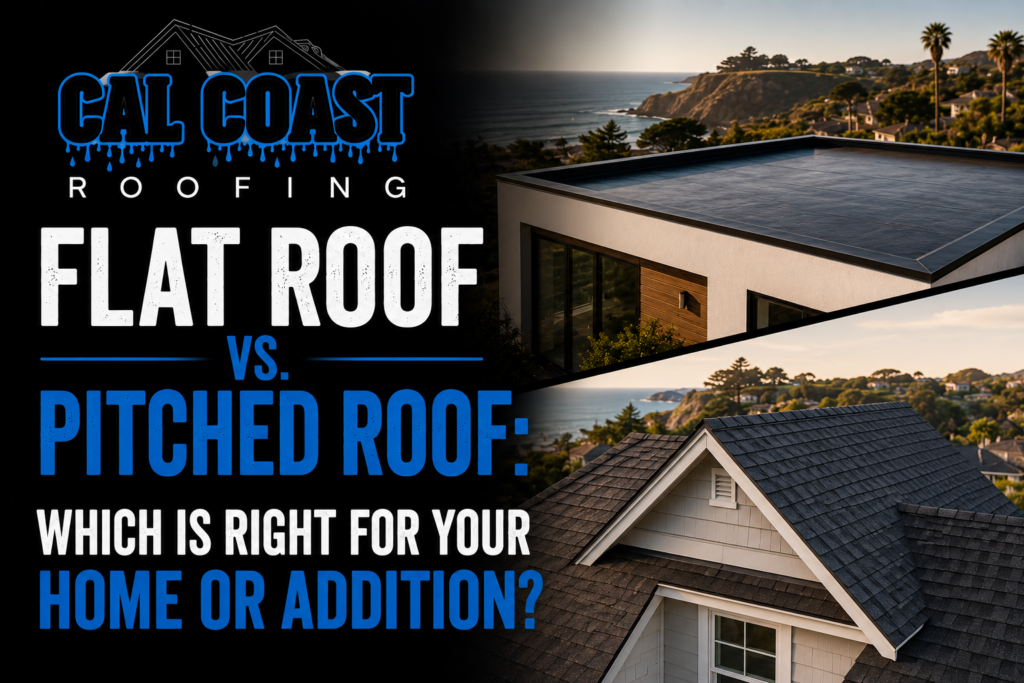
If you’re planning a home addition, an ADU, or considering a significant re-roof project, one of the fundamental decisions you’ll face is whether to use a flat (or low-slope) roof or a traditional pitched roof. Both are valid options — and both have genuine advantages depending on your goals, your home’s architecture, and your local climate. The key is understanding the trade-offs.
At Cal Coast Roofing, we install and maintain both flat and pitched roofing systems throughout the South Bay and Santa Cruz areas. Here’s a comprehensive breakdown of what each option offers.
Understanding the Difference
Before comparing the two, it helps to clarify the terminology.
Pitched Roofs
A pitched roof has a visible slope — measured as rise over run, or “pitch.” A 4:12 pitch, for example, rises 4 inches for every 12 inches of horizontal run. Most traditional homes have pitches between 4:12 and 9:12. Higher pitches shed water and debris more aggressively; lower pitches are more common in California’s milder climate.
Flat Roofs (Low-Slope Roofs)
Despite the name, truly “flat” roofs don’t exist in practice — they’re actually built with a slight slope (typically 1/4 inch per foot minimum) to allow drainage. Any roof with a pitch below 2:12 is considered low-slope and requires different roofing materials than a conventional pitched roof.
Pitched Roofs: Advantages and Limitations
Advantages
Natural Water and Debris Shedding
The slope of a pitched roof allows rain, leaves, and debris to run off quickly and efficiently. This reduces the risk of standing water, which is one of the primary causes of roofing system failure. In California’s rainy season, this matters.
Longer Lifespan for the Roofing System
Because water doesn’t pool on a pitched roof, the primary roofing material — whether asphalt shingles, metal, or tile — is under less constant stress. Asphalt shingles on a well-ventilated pitched roof can last 25–30+ years. Tile roofs can last 50+ years.
Attic Space and Insulation Options
A pitched roof creates attic space that can be used for storage, HVAC equipment, or even finished living area. The attic also acts as a thermal buffer between the living space and the roof surface, improving energy efficiency when properly insulated and ventilated.
Curb Appeal and Resale Value
In most Bay Area residential neighborhoods, pitched roofs are the architectural standard. A traditional pitched roof tends to complement existing home styles and is what buyers expect.
Limitations
Higher Initial Construction Cost
The framing required for a pitched roof — rafters, ridge boards, collar ties, and related structure — costs more to build than a simple flat-roof deck. This is especially relevant for additions where matching an existing roofline may add complexity.
Limited Usable Roof Space
The sloped surface of a pitched roof is not practical for rooftop equipment, solar panels (which require specific mounting), or outdoor living — though solar can be integrated effectively on south-facing slopes.
Flat Roofs: Advantages and Limitations
Advantages
Lower Construction Cost for Additions
For home additions, ADUs, garages, and commercial structures, flat roofs are significantly less expensive to frame and build. The structural simplicity translates directly to lower construction costs, which is a meaningful advantage when budgets are constrained.
Accessible Rooftop Space
A flat roof can serve as a functional platform for HVAC equipment, solar panel arrays, rooftop decks, or green roof installations. In urban and modern residential environments, flat roofs are increasingly chosen specifically for this versatility.
Modern Aesthetic Appeal
Contemporary and mid-century modern architectural styles frequently feature flat or low-slope rooflines. If your home has a modern design or you’re adding a structure that intentionally contrasts with a traditional pitched main roof, a flat roof can be the right aesthetic choice.
Easier Access for Maintenance
Walking on a flat roof is significantly easier and safer than navigating a steep pitched surface. This makes routine maintenance, equipment servicing, and inspections more straightforward.
Limitations
Drainage Is Everything
The primary vulnerability of a flat roof is drainage. When water pools — due to a blocked drain, inadequate slope, or membrane depression — it accelerates deterioration and dramatically increases leak risk. Flat roofs require more attentive maintenance than pitched roofs precisely because of this vulnerability.
Shorter System Lifespan
Modern flat roof systems — TPO membranes, modified bitumen, or built-up roofing (BUR) — typically last 15–25 years with proper maintenance. That’s a shorter lifespan than most pitched roofing systems. When budgeting for a flat roof structure, plan for the roofing system to need replacement at least once during the building’s life.
Greater Maintenance Requirements
Flat roofs require more frequent inspections than pitched roofs. Debris accumulates on the surface and around drains rather than shedding to the gutters. Seams in membrane systems can lift or separate over time and need periodic resealing. Neglecting maintenance on a flat roof accelerates deterioration rapidly.
Common Flat Roof Materials Used in California
If you choose a flat or low-slope roof, the two most common modern systems are:
TPO (Thermoplastic Polyolefin)
TPO has become the dominant flat roof material for both residential and commercial applications over the past decade. White TPO membranes reflect heat effectively, reducing cooling loads — an important benefit in California’s warm climate. TPO is heat-welded at the seams, creating a strong, waterproof bond. With proper installation and maintenance, TPO systems last 20–25 years.
Modified Bitumen
Modified bitumen is a multi-layer asphalt-based system that has been used reliably for decades. It can be applied in torch-down, cold-process, or self-adhered configurations. Modified bitumen is durable, cost-effective, and easier to repair than single-ply membrane systems.
Which Should You Choose?
The right answer depends on your specific situation:
- Matched addition to a traditional home: Pitched roof, to maintain architectural consistency and resale appeal.
- Modern home, ADU, or garage: Flat roof may be the appropriate choice both architecturally and economically.
- Budget-constrained addition: Flat roof typically offers lower initial construction cost.
- Long-term low maintenance priority: Pitched roof, particularly with architectural shingles, metal, or tile.
- Rooftop solar or equipment: Either can work, but flat roofs offer more mounting flexibility.
Talk to Cal Coast Roofing About Your Project
Whether you’re planning a new addition, replacing an existing roof, or evaluating options for an ADU, Cal Coast Roofing can walk you through the right system for your home, your budget, and your goals. We serve homeowners throughout San Jose, Saratoga, Los Gatos, Campbell, Santa Cruz, Scotts Valley, and the surrounding South Bay.
Contact us today to schedule a free roof inspection. We’ll give you straight answers — not a sales pitch.