If you’ve never had your roof professionally inspected, you might be wondering what the process actually involves. Is it invasive? How long does it take? What will you find out? And what happens if they discover a problem?
At Cal Coast Roofing, we believe homeowners should know exactly what they’re getting when they invite a roofing professional onto their property. This guide walks you through our inspection process from start to finish — so there are no surprises and you know precisely what to expect.
Why Roof Inspections Matter More Than Most Homeowners Realize
Most roofing problems don’t announce themselves loudly. They develop slowly, out of sight, over months or years — until they’ve caused enough damage to force attention. By then, what might have been a $400 flashing repair has become a $4,000 interior water damage restoration job.
Roofing professionals recommend annual inspections for most homes, and inspections after any significant wind or hail event. Regular inspections catch small problems early, extend the life of your roof, and give you the information you need to plan and budget for future maintenance or replacement.
If you’ve recently purchased a home, moved into a property where the roof’s history is unknown, or noticed any interior water staining, an inspection is the single best first step you can take.
Before the Roof Inspection: What We Ask You
When you contact Cal Coast Roofing to schedule an roof inspection, we’ll ask a few quick questions to help us prepare:
- How old is your roof? If you know, this helps us set realistic expectations. If you don’t know, we can often estimate based on what we observe.
- Have you noticed any leaks, staining, or water damage inside your home? Interior evidence is extremely useful for directing our attention to the right areas.
- Has your home been through any recent weather events? High winds, heavy rain, or falling branches can all cause damage that may not be obvious from the ground.
- When was your last inspection? If you’ve had prior inspections or repairs, any documentation you have is helpful.
This takes about 5 minutes and helps us deliver a more thorough inspection once we arrive.
The Inspection Process: What We Examine
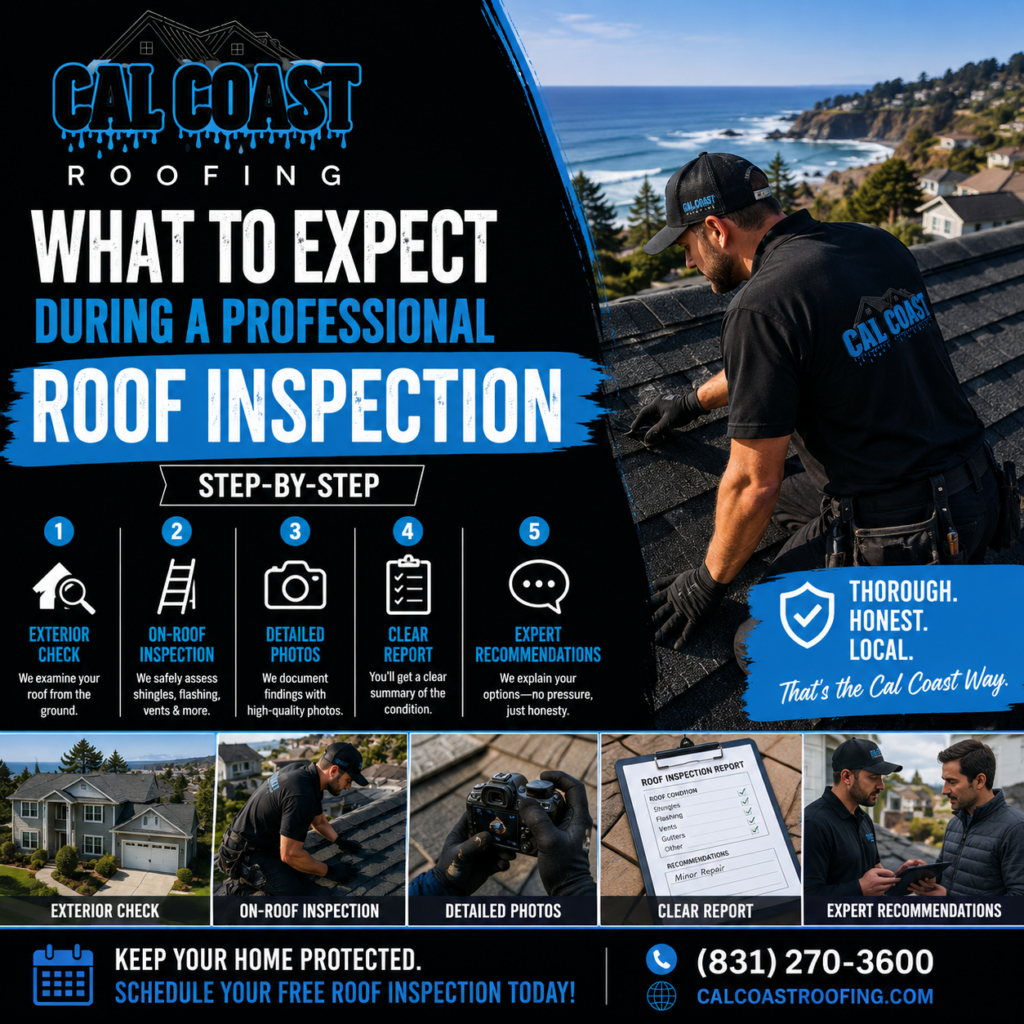
A professional roof inspection isn’t just a quick walk around the outside of your house. It’s a systematic evaluation of every component of your roofing system. Here’s exactly what we cover:
Exterior Roof Surface
This is where we spend the most time. We access the roof directly (where the pitch and condition allow) and walk a structured path across the entire surface. We’re evaluating:
Shingles: Checking for missing, cracked, curling, or blistering shingles. We also look for granule loss, which appears as thin or shiny patches where the asphalt surface is exposed. Granule loss is one of the most reliable indicators of shingle age and remaining lifespan.
Ridge Cap: The ridge cap seals the peak of the roof and is one of the most wind-exposed areas. We check for cracking, lifting, or missing cap shingles.
Valleys: Where two roof planes meet forms a valley, and valleys carry high volumes of water during rain. We check that valley flashing is intact and properly sealed with no lifted edges or rust.
Pipe Boots and Vent Flashings: Every plumbing vent, exhaust vent, and pipe penetration has a rubber or metal boot that seals it to the roof surface. These are among the most common sources of leaks, especially as the rubber ages and cracks. We inspect every single one.
Flashing Inspection
Flashing is the metal material used to seal transitions and intersections — and it deserves its own section because it’s responsible for a disproportionate share of roof leaks.
We inspect:
- Chimney flashing (step flashing, counter flashing, and saddle/cricket if present)
- Skylight flashing (a common leak source even on relatively new roofs)
- Dormer and wall step flashing
- Drip edge along eaves and rakes
We’re looking for rust, gaps, caulk failures, improper installation, and any areas where water could work its way beneath the flashing and into the roof assembly.
Gutters and Drainage
Gutters directly impact your roof’s health, so we include them in every inspection. We check for:
- Granule accumulation (indicates shingle wear)
- Blockages or debris that prevent proper drainage
- Sagging or pulling away from the fascia
- Proper slope toward downspouts
- Downspout extensions directing water away from the foundation
Attic and Interior Inspection
One of the most revealing parts of any roof inspection happens below the roof surface. With your permission, we access your attic and look for:
Moisture evidence: Dark staining, soft spots, or active mold on the roof decking or rafters indicates water has been entering the structure — sometimes for a long time before it’s visible inside the living space.
Daylight penetration: Any visible light coming through the decking means there are gaps or holes in the roof above.
Ventilation adequacy: We evaluate your attic’s intake and exhaust ventilation to ensure proper airflow. Poor ventilation is one of the leading causes of premature shingle failure and decking rot, and it’s something many homeowners have never had assessed.
Soffits, Fascia, and Eaves
The edge components of your roof protect the structural rafters and support your gutter system. We inspect for rot, pest damage, paint failure, and signs of moisture intrusion — all of which indicate larger issues with water management at the roof’s perimeter.
How Long Does an Inspection Take?
For a standard single-story home, expect approximately 45–60 minutes. For two-story homes, complex rooflines with multiple sections, or homes where the attic inspection reveals issues that require closer examination, the inspection may run 60–90 minutes.
We don’t rush inspections. A thorough evaluation is the only kind worth doing.
What You Receive After the Inspection
Once we’ve completed the inspection, we’ll walk through our findings with you in person — explaining what we observed, what it means, and what we recommend. You’ll receive:
- A clear summary of your roof’s overall condition
- Identification of any specific issues found and their severity
- Honest recommendations for repair, maintenance, or replacement (with no pressure either way)
- A written estimate for any recommended work
If your roof is in good shape, we’ll tell you that — along with what to watch for as it continues to age. Our goal is to give you accurate information, not to manufacture reasons to sell you a new roof.
Schedule Your Free Roof Inspection Today
Cal Coast Roofing offers free, no-obligation roof inspections for homeowners throughout San Jose, Saratoga, Los Gatos, Campbell, Santa Cruz, Scotts Valley, and the surrounding South Bay. Whether you have a specific concern or simply want peace of mind going into the rainy season, we’re here to help.
Call us or fill out our online form to book your inspection. We’ll give you a complete, honest picture of your roof’s condition — and the information you need to protect your home.